
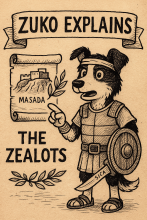
Who were the Zealots?
First-century Judea under Rome:
- A Jewish movement convinced that God alone is Israel’s true king; foreign rule (esp. Rome) was seen as illegitimate.
- Often called the “fourth sect” alongside Pharisees, Sadducees, and Essenes (cf. Josephus).
- Early inspiration/includes Judas the Galilean (linked to resistance around the census, c. AD 6; cf. Acts 5:37).
- Name comes from Greek zēlōtēs “zealous one,” echoing OT “zeal for the LORD.”
In the Time of Jesus
- One of the Twelve is Simon the Zealot (Matt 10:4; Mark 3:18; Luke 6:15; Acts 1:13).
- The Gospels don’t record militant actions by Simon; his allegiance to Jesus reframes former loyalties.
- Zealot ideals sat within wider Jewish debates about how to live faithfully under Roman occupation.
Key Beliefs & Traits
- God’s absolute Kingship
- Only God is Israel’s ruler; earthly overlords have no final claim.
- Active Resistance is required/demanded
- Many endorsed direct action against Rome and not just resistance; a related extremist wing, the Sicarii ('The dagger'), practiced assassinations. (Might be compared to the two wings of Ireland today, Political Sinn Féin and the IRA Irish Republic Army)
- They shared Theology with some other sects
- Overlapped greatly with Pharisaic belief in some doctrines, but with uncompromising political zeal.
- There was a Cost of Zeal and it was necessary if they were to achieve their goals.
- They intensified internal conflicts where ever possible to make it hard for the oppressors and during the inevitable the revolt; zeal without wisdom proved corrosive.
What they Became (Legacy)
- First Jewish–Roman War (AD 66–73): Zealot fervor helped ignite the revolt; Jerusalem fell in AD 70 and the Temple was destroyed. They whole way of life, culture and history wiped out.
- Masada (AD 73): Final holdouts chose death over surrender.
- After the war the movement fragmented; its memory remained as a warning about zeal turned violent.
Side note: Masada — The Last Stronghold
The Role Masada Played
After the fall of Jerusalem in AD 70, a group of Zealots and their families fled south to Masada — a remote desert fortress built by Herod the Great atop a towering plateau overlooking the Dead Sea. It became the final refuge of the rebellion.
The Romans under Lucius Flavius Silva laid siege to Masada in AD 73, constructing a massive earthen ramp on the western slope. When the Romans finally breached the walls, they found that nearly all defenders had taken their own lives rather than be enslaved. Their leader, Eleazar ben Ya’ir, reportedly urged them to “die free.” Thus Masada became the symbolic end of the First Jewish–Roman War.
Why Masada Was Important
- Strategic location: Masada rises over 400 m above the Dead Sea and commands the only major south-eastern land passage connecting Judea with Idumea, Edom, and Moab. Whoever held Masada could control caravan and military movement across this arid landbridge.
- Fortress engineering: Built by Herod between 37–31 BC, it featured palaces, storerooms, cisterns, and walls adapted to the cliffs — nearly impregnable from attack.
- Symbol of freedom and faith: For the Zealots, it was the last ground of “God’s Kingdom alone.” Later generations viewed it as a warning: zeal without mercy can consume the very faith it seeks to defend.
Biblical and Prophetic Connections
Masada itself is not named in Scripture, but its name means “fortress” in Hebrew (מצדה, metzada), echoing many verses that call God the true refuge:
- Psalm 18:2 – “The Lord is my rock, my fortress, and my deliverer.”
- Proverbs 18:10 – “The name of the Lord is a strong tower; the righteous run to it and are safe.”
In contrast to those spiritual images, the Zealots trusted literal walls. Their story invites reflection: Is my refuge built of stone or faith?
Revelation and the Wilderness Theme
The Dead Sea region and Judean wilderness — where Masada stands — form part of the prophetic landscape echoed in Revelation.
- Revelation 12:6, 14 – The woman (symbol of God’s people) flees into “the wilderness, a place prepared by God,” recalling Israel’s desert refuge near this same region.
- Revelation 16:16 – The final battle at Armageddon (Hebrew Har Megiddo) lies to the north, but the pattern of desert refuge and final conflict links back through Judea’s wilderness history — the same terrain where Zealots made their stand.
- Ezekiel 20:35-38 – God promises to bring His people “into the wilderness of the nations” for refining; early Christians may have seen the wilderness south of Jerusalem as a symbol of that testing.
While Revelation does not mention Masada by name, the wilderness refuge and final resistance themes mirror the fortress’ story — human zeal meeting divine sovereignty. The Masada valley is often referred to as the "Valley of Armageddon" before John wrote what he saw. It should be noted that the Book of Revelation is written in the Jewish literary style of 'apocalyptic'. Contrary to popular belief that term does NOT mean that it relates to the 'end of the world' but a complete style of writing. It just so happens that Revelation is about the end of the world. This style is not literal language but highly stylized imagery to evoke feelings and convey meanings in a way that can be decrypted by those that understand the literary style. I am not in anyway suggesting that the Valley of Masada is the actual place where the last battle of good and evil will be at Armageddon. It may be, it probably will not be, that is up to the Lord!
Legacy Today
Modern archaeology (Yigael Yadin, 1960s) uncovered the remains of the ramp, the palace, and hundreds of artifacts, confirming Josephus’s account. Today Masada is a UNESCO World Heritage site and a symbol of endurance. The modern phrase “Masada shall not fall again” expresses both memory and warning: faith must seek freedom in God, not only in stone.
Cross-reference: Zealots Legacy, Josephus — Jewish War VII 8-9.
Biblical References
- Simon the Zealot: Matt 10:4; Mark 3:18; Luke 6:15; Acts 1:13.
- Judas the Galilean: Acts 5:37 (an earlier revolt mentioned by Gamaliel).
- “Zeal” language: Gal 1:14 (Paul’s zeal for traditions—term overlaps but not necessarily “Zealot” membership).
- Contrast texts: Rom 13:1–7; 1 Pet 2:13–17 (Christian posture toward authorities).
- OT models of zeal (background): Num 25 (Phinehas); 1 Kgs 19:10 (Elijah’s zeal) often cited as inspiration.
Zuko’s Notes
Jesus called both a tax collector (Matthew) and a Zealot (Simon) into the same disciple band. In Christ, enemies become family. Zeal is good when shaped by love (cf. Rom 10:2), but destructive when it forgets mercy and the cross.
S.O.S. Reflection — The Zealots
S — What does it Say?
- What do the Gospels/Acts actually tell us about Simon the Zealot?
- What tensions between faith, power, and violence does this sect reveal?
- In the Gospels, Acts and Letters what political and military tensions do you see? What was the potential for the Zealots at the time to run a muck?
- What did Jesus and his disciples say and do that either encouraged the Zealots or tried to calm them down?
- Who cut off the guard's ear when they came to take Jesus away that night? Who would you have expected it to be? (Which Simon?) Matt 26:51-52, Mk 14:47, Lk 22:49-51, Jn 18:10-11. Again what did Jesus say/do to escalate/de-escalate the zealot violence?
- What does the fall of Jerusalem (AD 70) teach about misguided zeal?
O — How can I Obey / Apply?
- Where am I tempted to “force” outcomes rather than trust God?
- How can I channel zeal into prayer, patience, peacemaking, and service?
- What step this week shows unity with people I would normally oppose?
S — Who can I Share this with?
- Someone disillusioned by politics or activism who needs Jesus’ better way.
- A friend who thinks Christians must “win” by power; share Simon’s story.
- Small group: discuss zeal + love; pray for wisdom and gentleness.
Part of the “Following Zuko Explains — Jewish Sects” series.
Comments