
Archaeology and the Bible — Does the Ground Support the Record?
Start Here — Why Archaeology Even Matters
For generations, critics confidently stated that large portions of the Bible were historically unreliable. Entire people groups were said to be invented. Cities were thought fictional. Governors and rulers were dismissed as literary creations.
The argument sounded simple: if archaeology cannot find them, they probably never existed.
But archaeology is slow. Excavation is selective. And absence of evidence is not evidence of absence.
What makes this discussion fascinating is not that archaeology “proves” everything in the Bible. It does not. That is not how archaeology works. What makes it compelling is this:
Not sweeping theological claims. Small, ordinary, historical details.
And small details matter. Because legends rarely anchor themselves in verifiable geography, political titles, and architectural precision. Every other ancient manuscript known only paints with the broadest of brushes. Only the Bible goes down to People, year, month, sometimes day and time of day. Only the bible goes down to describe ordinary well known object or buildings as if painting a picture for someone that will never see them.
Let us look carefully at a few cases that changed the conversation.
The Hittites — A “Mythical” People Who Weren’t
In the 19th century, many scholars insisted the Old Testament had fabricated a people group called the “Hittites.” The Bible refers to them dozens of times — in Genesis, Joshua, Kings, and elsewhere.
The problem? No archaeological record had yet confirmed their existence.
Critics concluded: the biblical writers invented them.
Then excavation began in modern-day Turkey. In the early 1900s, archaeologists uncovered the ancient capital of Hattusa. Thousands of clay tablets were found. An entire Hittite civilisation emerged from the ground.1
What had been dismissed as fiction turned out to be a major Bronze Age empire.
This pattern would repeat. In fact, we are unaware of any proven incorrect archeological claims. There are some disputed ones over a matter of opinions, but none undeniably wrong.
It does not mean every biblical narrative is automatically confirmed. It does mean we should hesitate before dismissing it simply because something has not yet been found. The Bible itself tells us to:
Test claims.
Examine teaching.
Discern truth from error.
Verify prophecy.
Think carefully.
Avoid blind acceptance (Blind Faith).
(1 Thessalonians 5:21–22, 1 John 4:1, Acts 17:11 (Bereans), Proverbs 18:17, Proverbs 14:15, Deuteronomy 18:21–22, Luke 1:1–4, 1 Corinthians 15:3–8, Isaiah 1:18, & 2 Corinthians 13:5.)
The Pool of Bethesda — An Architectural Detail Too Precise?
In John 5, the Gospel describes a pool in Jerusalem called Bethesda, near the Sheep Gate, with “five covered colonnades” (five porticoes).
For centuries, no such pool had been identified. Some critics argued John was writing symbolically. Others assumed the author was geographically careless.
Then excavations near the Church of St Anne uncovered a pool complex with five porticoes — two large pools separated by a central dividing wall.2
The five-sided arrangement is unusual. It is not what someone unfamiliar with Jerusalem would likely invent.
John’s description was not vague. It was specific. And specificity matters.
This does not prove miracles happened at that pool. It does demonstrate that the author knew the city’s layout before its destruction in AD 70.
That detail alone pushes the dating of the Gospel earlier than many once claimed.
Pontius Pilate — A Name in Stone
The New Testament names Pontius Pilate as the Roman governor who authorised Jesus’ execution.
For a long time, Pilate was known primarily from the Gospels and from later Roman historian Tacitus.
In 1961, an inscription was discovered at Caesarea Maritima. It contained the name “Pontius Pilatus, Prefect of Judea.”3
The inscription was not Christian. It was Roman.
That level of administrative accuracy is noteworthy. Legends rarely preserve correct bureaucratic terminology. Also Pilot was soon disgraced after the events of the Crucifixion and lost his position. Again, this not only confirms that there was a person of that name in that position but it also confirms the date range!
Again — small detail. But cumulative weight matters.
The Tel Dan Inscription — “House of David”
King David was often described by sceptics as a national legend — a tribal hero inflated into mythology. Similar to the mythical "King Arthur" stories.
In 1993, fragments of a 9th-century BC Aramaic inscription were discovered at Tel Dan. The inscription refers to the “House of David.”4
This was not a biblical document. It was written by a neighbouring king boasting of victory.
In the ancient Near East, dynasties were identified by founding figures. “House of David” implies David was a recognised historical founder.
That shifts the conversation from “Did David exist?” to “How large was his kingdom?”
The debate moved because the ground spoke.
Luke and Acts — An Author Obsessed with Geography
The author of Luke and Acts names ports, islands, political titles, regional officials, and travel routes with striking precision.
He distinguishes between local rulers using terms like “tetrarch,” “proconsul,” and “politarch.” These are not interchangeable labels.5
For example, Acts 17 uses the term “politarch” for Thessalonian officials. For years critics claimed this was an invented word.
Later inscriptions from Thessalonica confirmed the exact title.6
Luke does not read like someone writing centuries later from a distant location. He reads like someone either present or carefully interviewing eyewitnesses.
And Luke himself opens his Gospel stating he investigated matters carefully from the beginning (Luke 1:1–4). There are sections of his writing that he indicates that he himself was present to witness the events. (Acts 16:10-17, Acts 20:5–15, 21:1–18, 27:1 – 28:16)
Archaeology does not confirm theology. But it repeatedly confirms Luke’s geography and political awareness. For the longest time, some cities and regions were disputed as incorrect or made up. All have now been vindicated.
The Coin of Caesar — Politics, Power, and Precision
When Jesus was asked whether it was lawful to pay taxes to Caesar (Matthew 22:15–22), the question was explosive.
Judea was under Roman occupation. Taxation was not just economic — it symbolised submission.
Jesus asked for a denarius (the coin used to pay taxes to Rome). “Whose image is this, and whose inscription?”
The most common silver denarius in circulation during that period bore the image of Tiberius Caesar, with the inscription:
That was not neutral wording. It declared Caesar divine — the “son of a god.”
The coin itself was propaganda. Roman emperors used currency to spread political theology across the empire.
Jews worship only one God! It is there primary and first commandment. Talk about a loaded question he had to answer!
His answer astounded the questioner and the crowd. He forestalled his execution until a later time of his choosing.
When Jesus replied, “Render to Caesar the things that are Caesar’s, and to God the things that are God’s,”
It was assumed that he was holding a coin that claimed divinity for a man. It was assumed that this was only a story, for it was common knowledge that no Denarius had "Caesar" inscribed upon it. Rather, the full name of the Emperor.
That moment only works in a historically specific setting — Roman Judea under Tiberius.
Coins are datable, stamped artefacts. They are among the most reliable archaeological evidence we possess. They anchor digs and stories to particular rulers, in particular places, and time periods.
The Gospel writers do not describe a mythical emperor. They assume the real political currency of their world.
That does not prove theology. But it demonstrates setting — and setting matters. Or blows it out of the water!
Have a look at these coins:
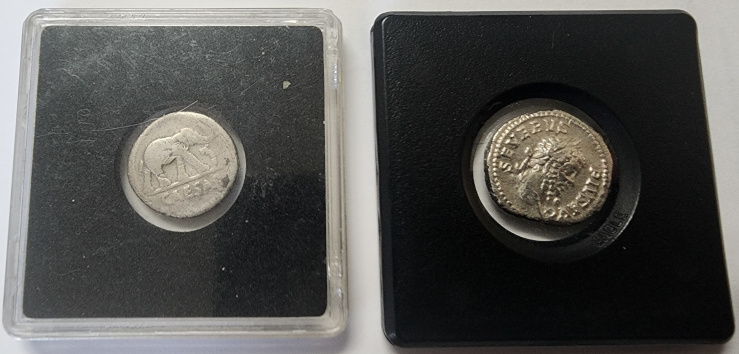
It was once long denied that any silver Denarius coin every had the inscription of "Caesar" on it as described Mark 12:13–17, Matthew 22:15–22, and Luke 20:20–26. Both the Denarius coins of Tiberius and Julius Caesar in circulation at the time and place of Jesus included the word “CAESAR". This shows us firstly that Roman Coins were in common use in Judea at that time. Secondly that "Caesar" was used in 1st‑century coinage. Lastly, if Jesus was holding Julius Caesar's coin and not Tiberius' then he would have even avoided the question of worshipping another god as well! What other ancient manuscript, other than the Bible, goes down to this level of granularity? Does this sound like a myth or legend to you? (The Elephant was the Signet image that was used for Julius Caesar whilst he was still alive. It was expected that your family put your face on a coin after your death to commemorate you.)
The Dead Sea Scrolls — A Time Capsule Before Christ
In 1947, a young Bedouin shepherd searching for a lost goat threw a stone into a cave near the northwest shore of the Dead Sea. The sound it made led to one of the most important manuscript discoveries in history.8
Inside clay jars were ancient scrolls — biblical manuscripts and community writings — eventually dated between roughly 250 BC and AD 70.
Until that moment, the oldest complete Hebrew Bible manuscripts dated to around AD 1000.
That left a gap of nearly a thousand years between the original writings and our earliest full copies.
The Great Isaiah Scroll
Among the scrolls discovered was a complete copy of the Book of Isaiah — now known as 1QIsaᵃ — dated approximately 125 BC.9
When scholars compared it to the later Masoretic Text (the medieval Hebrew tradition), the result was remarkable.
There were spelling variations. Minor word differences. Occasional scribal slips.
But the message — the content, the structure, the theology — remained overwhelmingly consistent.
Over a span of roughly one thousand years, the text had not morphed into something else.
The Essenes — A Community Devoted to the Text
Most scholars associate the Qumran community — the group likely responsible for preserving these scrolls — with the Essenes, a Jewish sect living in the Second Temple period.10
The Essenes were known for:
- Strict communal living
- Ritual purity practices
- Daily immersion washings
- Devotion to Scripture
- Careful copying of sacred texts
They saw themselves as guardians of truth in a corrupt age.
Their community library included:
- Copies of nearly every Old Testament book
- Commentaries (called “pesharim”)
- Community rule documents
- Apocalyptic writings
When the Romans advanced during the Jewish War (AD 66–70), these scrolls were likely hidden in caves for protection.
They remained untouched for nearly two thousand years.
Why This Matters for Trust
The Dead Sea Scrolls answer a quiet but serious question:
“Was the Old Testament rewritten long after the events?”
The Scrolls show that the Hebrew Scriptures circulating before the birth of Christ are substantially the same Scriptures preserved afterward.
That stabilises the foundation.
It means when the New Testament writers quote Isaiah, Psalms, or Deuteronomy, they are quoting texts already in circulation — not later creations.
The Scrolls do not eliminate every debate. But they remove the idea of wholesale textual corruption.
That is historically significant.
A Pattern Emerges
None of these discoveries independently prove divine inspiration.
But consider the pattern:
- People once dismissed — confirmed.
- Places once doubted — located.
- Titles once questioned — verified.
- Architectural details once unknown — uncovered.
When a document repeatedly aligns with recoverable history, it earns credibility.
Legends typically grow in vagueness over time. They drift into symbolic landscapes. They lose bureaucratic precision.
The Bible does the opposite. It embeds itself in recoverable reality.
Conclusion — What Should We Do With This?
Archaeology has not answered every question. Nor should we expect it to.
But the repeated confirmation of once-dismissed details should slow down sweeping claims that the Bible is historically careless or fabricated.
If the writers were consistently accurate in small, verifiable matters — geography, officials, architecture — then dismissing them entirely requires more than assumption.
It requires explanation.
That is a question worth exploring.
Here are some external documentaries that you can watch if you are interested. (Don't forget to come back here when you are done going down the rabbit hole and continue your journey.)
Continuing the Journey
If archaeology repeatedly confirms historical details, what about the text itself? Has it been altered over centuries — or do we still possess what was originally written?
→ Next: Bible Manuscript Evidence — Has It Been Altered?
← Return to Hub: Can the Bible Be Trusted?
Footnotes
- Excavations at Hattusa (modern Boğazköy), early 20th century.
- Excavations near St Anne’s Church, Jerusalem, late 19th century.
- “Pilate Stone,” Caesarea Maritima, discovered 1961.
- Tel Dan Stele, discovered 1993–94.
- Roman administrative titles in Acts.
- Thessalonian inscription confirming “politarch.”
- Silver denarius of Tiberius Caesar (reigned AD 14–37), commonly bearing inscription “TI CAESAR DIVI AVG F AVGVSTVS.” Frequently identified as the likely tribute coin referenced in the Synoptic Gospels.
- Discovery of the Dead Sea Scrolls at Qumran beginning in 1947; manuscripts dated approximately 3rd century BC to 1st century AD through palaeographic and radiocarbon analysis.
- The Great Isaiah Scroll (1QIsaᵃ), dated c. 125 BC, compared with the Masoretic Text tradition (c. AD 1000), demonstrating substantial textual continuity.
- The Qumran community widely identified with the Essenes based on archaeological, literary (Josephus, Philo, Pliny), and textual evidence.
Comments